
Definition of Terms in Research: Format, 5 Examples, and Template
Definition of terms in research with a thesis-ready format, five examples, an operational definition template, and practical quality checks.
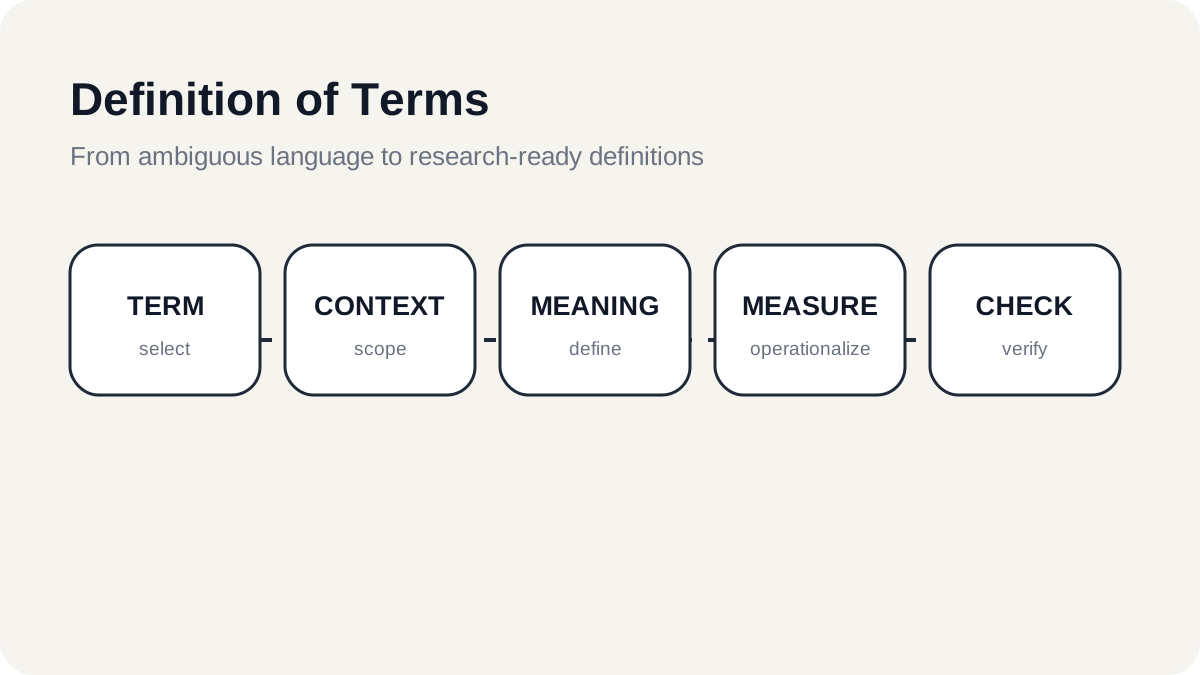
The definition-of-terms section makes a paper easier to read by fixing the meaning of important concepts before readers reach the analysis. The strongest versions focus on terms that could otherwise be interpreted in more than one way.
Quick answer: what belongs in a definition of terms section?
Include specialized concepts, abbreviations, study-specific labels, and variables whose meaning depends on how the research measures or uses them. Skip ordinary words that do not need clarification.
What a definition of terms section does
A useful definition tells the reader what a term means in the context of this study. It reduces ambiguity, makes variables easier to trace, and keeps terminology consistent across the introduction, methods, figures, and results.
Where definition of terms goes in a research paper
Placement depends on the institution or journal. In theses and dissertations it commonly appears near the introduction or conceptual framework. In shorter papers, essential definitions can be introduced where the term first appears.
Conceptual vs. operational definitions
A conceptual definition explains the general meaning of a term. An operational definition explains how the study observes, calculates, classifies, or measures it. Research writing often needs both.
How to write definition of terms
Start with the term, state the study-specific meaning in one or two precise sentences, then add the measurement rule when the term is operationalized. Reuse the same wording throughout figures, tables, and prose.
Weak vs. strong definitions
A weak definition repeats a dictionary meaning without connecting it to the study. A strong definition removes a realistic ambiguity and gives the reader enough information to interpret later evidence correctly.
Five definition-of-terms examples
- Treatment response: the percentage change from the baseline score after the final intervention session.
- High engagement: participation in at least 80% of assigned learning activities during the study period.
- Urban site: a sampling location classified as urban by the study's stated population-density threshold.
- Recovery time: elapsed time from the end of a perturbation until the measured signal returns to the defined baseline range.
- Positive sample: a specimen that meets the assay threshold and quality-control requirements specified in Methods.
Operational definition template
Use this compact pattern: Term — what it means in this study; how it is measured or classified; unit, threshold, or time window when relevant.
Practical quality checks
Confirm that every defined term is actually used, that units and thresholds match the Methods section, and that labels in diagrams or tables use the same wording. Remove definitions that add no study-specific information.